Cambridge IGCSE Grades Explained: A* to G, 9 to 1 and Equivalence in India
A Cambridge IGCSE statement has no total and no percentage. It lists a grade against each subject. For families used to Indian marksheets, this raises fair questions: is a C a pass, what is the difference between Core and Extended, and will an Indian junior college accept it?
In this article
The grade scale
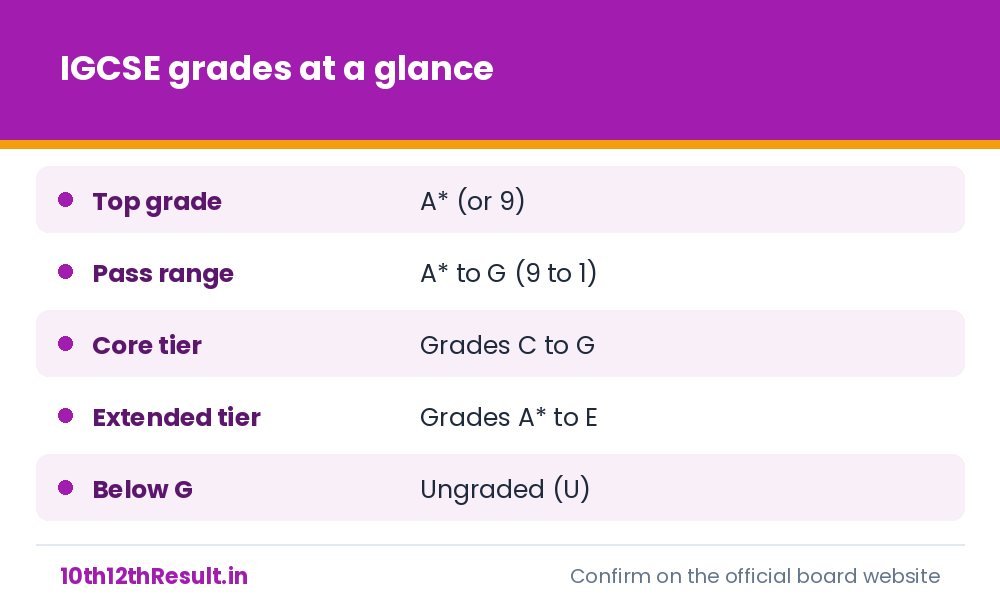
Cambridge IGCSE is graded from A* to G, with A* the highest. Some schools enter students for syllabuses graded 9 to 1 instead, where 9 is the highest. A result below the lowest grade is shown as U (ungraded), which means no grade was awarded.
Core and Extended: why the tier matters
In many subjects the school chooses a tier for each student:
| Tier | Grades available | Suitable for |
|---|---|---|
| Core | C to G | Students aiming for a secure pass in that subject |
| Extended | A* to E | Students aiming for higher grades or planning the subject in Class 11–12 |
A Core candidate cannot get higher than C however well the paper goes. If you plan science or mathematics later, discuss the tier with your teacher well before entries are made.
Other entries you may see on the statement
- Percentage uniform mark: some statements carry a standardised mark that shows where you stand within a grade. It is not the same as raw marks.
- X or “no result”: a component was missed or the result is pending.
- Q: the result is awaiting a decision; the school follows up.
Is IGCSE recognised as Class 10 in India?
Yes. IGCSE is treated as a Class 10 qualification, and Indian boards and junior colleges admit IGCSE students to Class 11. The usual expectation is passes in at least five subjects including English. Individual boards and state admission systems can add their own conditions, so check with the institution you are applying to.
How Indian institutions convert grades
There is no single official conversion from letter grades to percentages. Three things happen in practice:
- The school issues a letter stating percentage marks or a grade-to-marks range.
- The admitting college or state portal applies its own conversion table.
- Where available, the percentage uniform mark is used.
Ask the admitting institution which of these it accepts before you fill in a percentage yourself.
After IGCSE: the routes
- Cambridge AS and A Level in the same system.
- IB Diploma.
- CBSE, ISC or a state board for Class 11 and 12.
Students who later need an Indian Class 12 equivalence for university admission should confirm the current requirements of the Association of Indian Universities.
For result months, see IGCSE result 2027 release dates.
This is an independent information website and is not affiliated with any education board. Always confirm dates and rules from the official board notification.
Related guides
Cambridge IGCSE Result 2027: Release Dates for March, June and November Series
Cambridge IGCSE has three exam series, and each has its own result month. See when Indian students get results in 2027, how…